

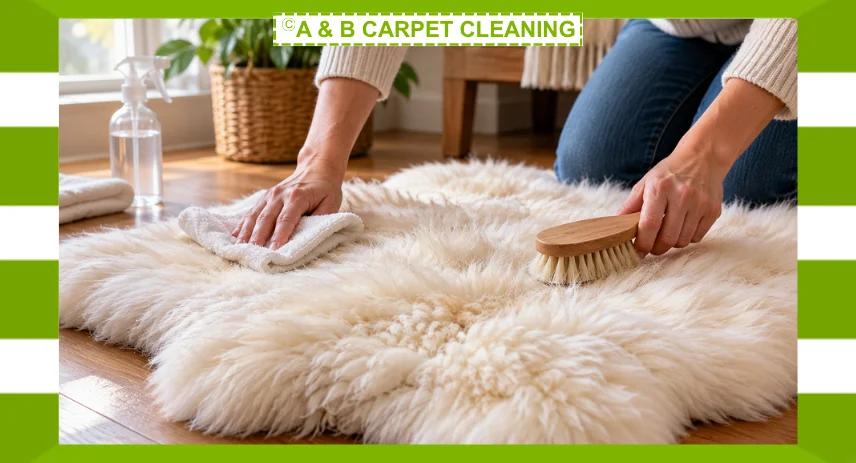
The safest way to care for sheepskin is to remove dry soil gently, brush the wool, treat spills quickly, and use full washing only when the care label allows it. If you are learning how to care for sheepskin rug surfaces, remember that genuine sheepskin combines wool with a natural hide backing, so excess water, heat, rough agitation, and unsuitable cleaners can affect either part. Routine care should do most of the work.
Before wet treatment, identify whether the rug is natural, dyed, aged, or specially processed. At A&B Carpet Cleaning, we use this material-first process before choosing rug care.
Why Sheepskin Reacts Differently From an Ordinary Rug
A genuine sheepskin rug is not constructed like a woven wool rug. The wool remains attached to the hide, so cleaning has to respect two connected materials with different responses to moisture, heat, pressure, and movement.
The National Park Service wool-care handbook identifies wool as an animal fiber and notes that wet treatment can interact with dyes and other materials. Its guidance is written for museum collections, not household rugs, but the material principle is useful: identify what you have before adding water.
How to Care for a Sheepskin Rug Between Deeper Cleanings
Regular sheepskin rug care is mostly dry maintenance. Take the rug outdoors and shake it gently when practical. Loose crumbs, grit, and hair are easier to remove before they settle into the fleece.
If vacuuming is permitted, use controlled suction without a rotating beater bar. Work slowly instead of pressing the nozzle into the wool. A suitable sheepskin or wool brush can help separate flattened strands.
Rotate the rug occasionally if one side receives more foot use or daylight.
How to Clean a Sheepskin Rug After a Spill
Blot a fresh spill immediately with a clean white towel. Press and lift so the towel absorbs liquid. Do not scrub sideways because rubbing can spread the mark and disturb the wool.
Check the care label before applying any cleaner. If spot cleaning is allowed spot cleaning should be tested on a visible section first. Use the smallest amount of moisture needed and keep the hide from becoming unnecessarily wet.
An unknown stain, unstable color, or stiff backing is a reason to reassess the method instead of repeating wet treatment.
How to Care for Sheepskin Rug Cleaning Maintenance by Condition
The rug's condition should decide the next step, not the stain alone.
|
Rug Condition |
Sensible First Step |
What to Avoid |
|
Light dust |
Shake and gentle vacuum |
Heavy brushing |
|
Flattened wool |
Light grooming |
Pulling hard |
|
Fresh spill |
Blot promptly |
Scrubbing |
|
Washable rug |
Follow its care label |
Hot water |
|
Dyed or older rug |
Test and assess first |
Automatic full washing |
|
Stiff hide |
Stop repeated wet care |
Forced heat |
Washing Sheepskin Rug Only When the Label Permits It
Washing sheepskin rug material is not automatically the next step when the fleece looks dull. Remove dry soil first and decide whether the entire rug needs wet cleaning.
If the label allows hand or machine washing, follow its water temperature, cycle, and product instructions exactly. Do not copy another rug's method because tanning, dye, stitching, age, and finishing can differ.
After an allowed wash, avoid twisting or wringing the hide. Support the wet rug, reshape it gently while damp, then dry it away from direct heat.
Drying Matters as Much as Washing
Slow, supported drying helps reduce avoidable stiffness and distortion. Lay the rug according to its care directions in an area with steady airflow. Keep concentrated heat away from the hide.
The National Park Service leather-and-skin care handbook stresses preventive care for leather and skin materials and warns against routine dressings on collection objects. Household sheepskin is different, but that caution supports avoiding random oils or leather treatments unless the rug maker recommends them.
Case Example: A Flattened Bedside Sheepskin with one Drink Mark
Consider a small natural sheepskin beside a bed in a Brooklyn apartment. The wool has flattened where feet land, and a drink left a damp mark near one edge.
The owner wipes the spill. Lets the spot dry naturally without using heat. After looking at the care tag the rug is taken outside. Shaken gently. It’s groomed carefully. Not washed completely.
A minor spill and flattened pile did not automatically trigger full immersion. This is an illustrative example, not a customer result.
6 Common Sheepskin Care Mistakes that Create Extra Work
Most avoidable problems come from treating sheepskin like ordinary laundry.
-
Skipping the label: A method that works for one pelt may not suit another.
-
Using hot water: Heat can change the wool and hide during washing.
-
Scrubbing stains: Friction can spread residue and roughen the affected area.
-
Wringing a wet rug: Twisting places unnecessary stress on the damp hide.
-
Drying with strong heat: Fast heat can leave the backing less flexible.
-
Adding random conditioners: A home remedy may darken, coat, or change the backing.
What You Can Do at Home and What Professional Care Changes
At home, you can handle routine shaking, careful vacuuming, gentle grooming, and quick blotting. You can also follow a clearly washable care label when the rug is sound and the instructions are specific.
Professional care becomes more practical when the rug is dyed, valuable, heavily soiled, unusually stiff, strongly odorous, previously mishandled, or marked by an unknown stain. Assessment starts with construction, backing condition, color stability, and prior treatment rather than assuming every sheepskin can take the same wash.
Our area rug cleaning service explains how A&B approaches rug cleaning by material and condition. You can also compare general maintenance principles in our area rug care guide before deciding whether home care is enough.
Give Your Sheepskin a Safer Reset With A&B Carpet Cleaning
If routine care is no longer enough, A&B Carpet Cleaning can assess the rug before a deeper method is chosen. That is useful when the backing feels different, the wool changed after an earlier wash, or a stain keeps returning after home treatment.
Use our contact page to discuss the rug or check our service areas page for Brooklyn coverage, including Bay Ridge, Bensonhurst, Bushwick, Crown Heights, Park Slope, Williamsburg, and other listed neighborhoods. Call (718) 431-8484 to ask about appropriate area rug care before trying another wet treatment.
Frequently Asked Questions
Yes. Heavy furniture can compress wool rugs, leaving impressions. Place furniture carefully, check contact points regularly, avoid dragging to prevent distortion, and ensure the rug remains flat without sharp corners pressing too hard.
Store it only when fully dry. Follow the maker's storage directions, avoid tight folds that strain the hide, and choose a clean, dry location where the rug is not crushed beneath heavy items. Inspect it before returning it to use.
A color shift can happen for reasons including getting older being exposed to light washing in the past and changes, in the wool or the backing. Do not think that whitening products are always safe. Look at the care instructions. Get the rug checked if the change is noticeable or not even.